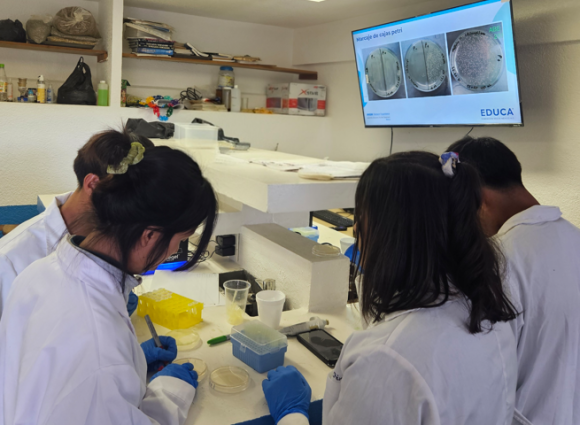
Nothing can get in the way of science learning at ABE Mexico. Power outages, language barriers, low internet connectivity—each challenge is met with innovation and a strong will to overcome. This can-do mindset has especially benefited Nuestros Pequeños Hermanos, a children's home and school with more than 70 years of experience serving children and youth from low-income families. There, both middle school and high school students are engaging in hands-on science through the ABE curriculum.
“Students are becoming familiar with real laboratory environments and scientific tools that previously seemed distant or inaccessible,” says Andrea Flamand of Fundación EDUCA México, the program site lead for ABE Mexico. “Many have shared that participating in ABE has helped them feel closer to science and view it as attainable.”
Most students who live at Nuestros Pequeños Hermanos come from insecure family and community environments. When ABE first piloted the program there in 2023, it began with middle school students at the secondary school campus in Miacatlán, Morelos—about 1 hour from Cuernavaca, the state capital. Since then, the program has expanded to high school students. Prior to ABE, the students had never seen laboratory equipment such as micropipettes or electrophoresis machines, so the equipment generated great enthusiasm, according to the ABE Mexico team.
A significant challenge has been supporting students whose first language is Mixtec rather than Spanish. “Helping them understand ABE content in their own language required additional effort, which we successfully addressed thanks to biology teacher Ms. Blanca,” Flamand says. “She developed educational materials such as mind maps, posters, summary tables, and bilingual dictionaries explaining the content in both Mixtec and Spanish. Several students also found it engaging to translate scientific ABE concepts into their native language.”

The ABE Mexico site coordinators say that both middle and high school teachers have consistently shown willingness to learn, innovate, and ensure that each student understands the objectives of the ABE laboratories.
The teacher at the middle school level has frequently used her personal cellphone to connect students to virtual science fair tutorials, as the school lacks reliable internet access. She also learned to use a virtual learning platform called TICMAS to teach biotechnology theory to her third-year students. “It was especially rewarding to see students arrive at the laboratory with a clear understanding of what they were doing and why,” Flamand says. Similarly, at the high school level, the teacher has used LabXchange to supplement learning.
On one occasion, there was a power outage halfway through the labs. “The students were so enthusiastic that we connected a car battery to power the equipment,” Flamand says. “They loved the experience!”
ABE Mexico has also organized a visit to the local UNAM (National Autonomous University of Mexico) Center for Genomic Sciences, which included stops at the Prokaryotic Functional Genomics Laboratory—where students learned about DNA extraction, plant cultivation, and electrophoresis—and a visit to the greenhouse. At the Systems Biology Laboratory, after the lead researcher gave a presentation on systems biology, students played a board game to reinforce the concepts and then had the opportunity to load an electrophoresis gel into a Bio-Rad chamber. Finally, students visited the Genomic Ecology Laboratory, rotating through stations focused on plants, insects, mammals, and fungi.
These student activities at Nuestros Pequeños Hermanos help strengthen education for those with limited access to opportunity. “Many students come from extremely challenging backgrounds, including exposure to organized crime and child labor,” Flamand says. “For this reason, implementing ABE at Nuestros Pequeños Hermanos has contributed significantly to advancing the shared goals of ABE and EDUCA.”
ABE Mexico is excited for the year ahead, which includes their new mascot, Coli. This mascot will help raise awareness of the program among new students, the team says, and support EDUCA in promoting ABE alongside its financial and environmental education initiatives.