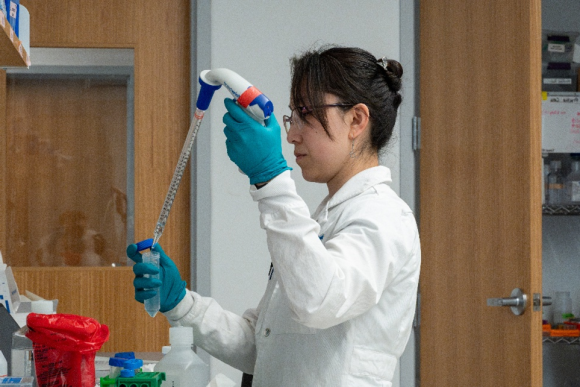
Excitement is in the air in a biology classroom in Tampa, Florida. As Mishell Thomas-King explains how her students will be trying out a new lab next quarter that lets them test their own DNA, a student reacts simply with “Oh my gosh! Really?”
“I said, ‘You get to test whether or not you have a particular trait, then swab your own cheek cells, and then identify whether or not you have the gene for that trait by running a gel.’ They were so excited!” says Thomas-King, an ABE teacher at Alonso High School.
The lab that Thomas-King was telling her student about is ABE’s newly revamped Exploring Precision Medicine module. A couple of years in the making, the module debuts this month with a new storyline about an anti-clotting drug, a fresh focus on bioinformatics, and updated resources.
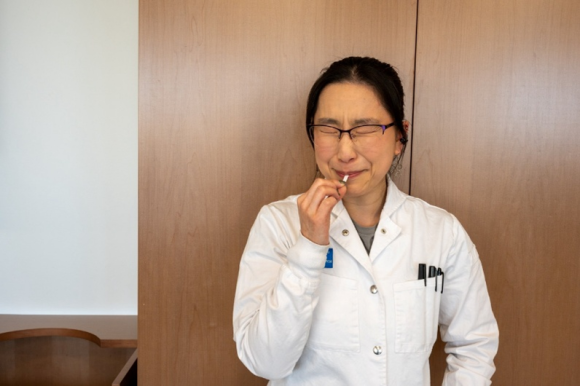
As in previous versions, the module starts with students touching strips of paper to their tongues to see whether they are sensitive to the chemical phenylthiocarbamide (PTC). Some will taste strong bitterness (“supertasters”), whereas others may taste nothing, with a whole spectrum in between controlled by their genes. Students then learn how to run a polymerase chain reaction (PCR) and perform gel electrophoresis on DNA samples from their cheek swabs to see how the genomic results compare to their tasting results.
The previous iteration of the module centered on precision, or personalized, medicine approaches to the efficacy of opioid addiction treatment options. “But we wanted something in the revamped module that aligns more closely with a more widely used precision medicine example,” explains Tara Bristow, ABE implementation and technician director. “So, the new storyline is about how physicians determine whether a patient is a good candidate for an anti-clotting medication.” The drug, clopidogrel, relies on activation of the CYP2C19 gene, which can vary from person to person, mirroring the relationship between supertasters and the gene for supertasting.
“Anything where students can test something that actually comes from them and directly applies to their lives is more beneficial,” Thomas-King says. “A lot of times I try to make those connections in class, but if they can have hands-on experiences to connect their traits to genetics, for example, it is so helpful.”
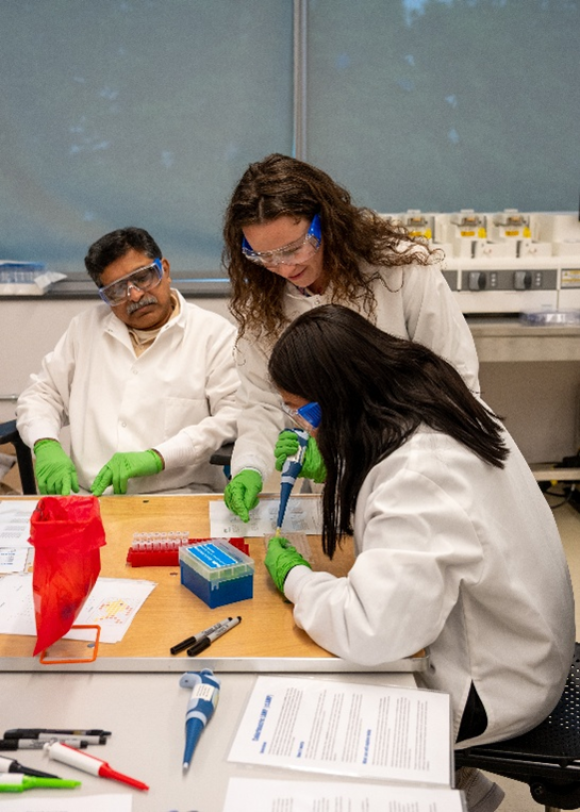
Having such a tangible experience is transformative for the learning process, says Carolina Sarmiento, who coordinates the ABE program in Tampa. It’s something she wishes she had earlier in her own science career. A microbial ecologist who manages a lab at the University of South Florida in addition to her work with ABE, Sarmiento grew up in Colombia with a very basic exposure to biology in high school and limited lab resources in college.
“Just thinking about how ABE students have the opportunity to grow bacteria, the opportunity to do PCR, is amazing,” Sarmiento says. “I always knew I liked science, but discovering earlier how much I loved working in the lab probably would have helped me decide which area of science would fit me best and make that career decision with more confidence.”
Sarmiento started working with ABE Tampa in 2020, right before schools shut down due to the COVID-19 pandemic. At that time, schools in the area had only just started using the abridged series of ABE labs and had not yet started working with PCR. She remembers teachers’ excitement when they were finally able to run the full PCR labs after purchasing a thermocycler, and later, when she introduced them to the Exploring Precision Medicine module at a professional development institute earlier this year.
“The teachers were so excited,” she says. And now, to be able to start piloting the new Exploring Precision Medicine module, Sarmiento says that the demand is high. “Especially for the teachers working on genetic aspects of molecular biology, they feel that this module is a better fit for teaching some courses than the Foundations of Biotech series.”
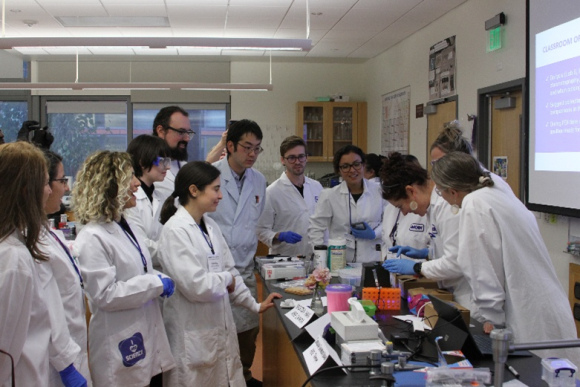
Sarmiento also welcomes the module’s greater focus on bioinformatics, something she only started working with in graduate school. While working with Bristow and the implementation team on the module revisions, she felt it was important to emphasize both real-world skills and content that will help give students early and strong exposure to the life sciences.
After introducing Exploring Precision Medicine at a recent ABE Tampa teacher training, Thomas-King enthusiastically volunteered to be among the first to test it in the classroom. “I told them that we wanted to be guinea pigs,” she recalls.
And Thomas-King’s class will not be the only one piloting the module during the first few months of 2026. Early adopters also include sites in Massachusetts, Kentucky, San Francisco, and the greater Los Angeles area. “Blood, sweat, and tears have been shed over this module for more than a year,” Bristow says, “and we could not be more thrilled to bring this new content to teachers and students alike.”