It is never too late or too early to try something new—especially when it comes to hands-on science. For two new teachers and one seasoned teacher, using the ABE curriculum and labs in their classes this past school year showed how impactful hands-on science experiences can be for students and teachers alike. Whether teaching in Mexico, Ireland, or the United States, these educators have embraced the novelty to create thriving learning environments.
“I learned a great deal from working with ABE—especially facing the new and unknown during my first year as a recent graduate,” said Ivonne Arely Alonso Becerra, a secondary school chemistry teacher at República de Panamá Day Secondary School No. 77 in Mexico City, in a translated interview. “I learned to trust my students and to instill confidence in them. I realized that just as they learn from me, I learn from them—and, above all, I learned more about science.”
A first-time ABE teacher who has been teaching secondary school for 2 years, Alonso was thrilled to see her students’ excitement when conducting the experiments and their amazement at everything they were learning. “They would relate concepts to their daily lives and were eager to learn more,” she said. Supporting that level of engagement, however, requires a “high level of professional guidance and dedication.”
Doing something entirely new, Alonso said, filled her and her students with nervousness, but the process of learning together helped them overcome any challenges. As part of the ABE Mexico program, her students made a podcast about the labs. “One student was very nervous and afraid to participate. During the recording, he had to repeat his lines many times because he was struggling to find the words,” she said. “But when we finally finished, he smiled and shouted, ‘We did it!’ and we all had a laugh. This shows how the learning impacts their daily lives, their self-confidence, their sense of belonging to the school, and their personal assurance.”
For first-time ABE teacher Dee Rafferty, who teaches at St. Kilian's Deutsche Schule in Dublin, the primary challenge was teaching her students to be patient. “For example, several students started to do the lab without putting on gloves,” she recalled. “Other students opened the fridge door to get a glimpse of the DNA.”
During all these experiences as a student teacher graduating this year, Rafferty saw a huge benefit in sparking her students’ interest in science and discovery. They especially enjoyed engaging in a related forensics lab, using DNA samples and gel electrophoresis to identify a jewel thief. “To explain the impact on my students, it is easiest to just say that the students did not want to leave the classroom when the bell rang; they would usually just bolt out the door without a backwards glance,” she said.
Rafferty, who found a second career in teaching after working as an anesthesiologist for 10 years, is excited to continue with ABE next year. “It has increased my students' technical skills, their curiosity, and their understanding of the link between science and its real-world applications.”
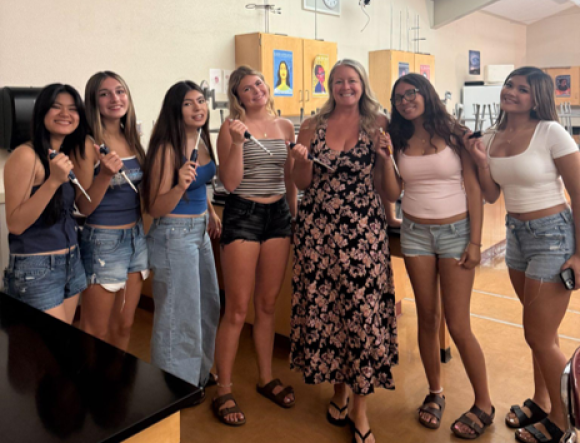
For seasoned teacher Corey Spainhower, ABE has helped her students feel like scientists. “They were actually the most well behaved and engaged I have ever seen them doing lab group work,” she said. “Part of it was talking about how the materials and expensive equipment came from the University of California, Berkeley, and the Lawrence Hall of Science [via ABE San Francisco Bay], as they all grew up so in awe of these two establishments. They knew they were getting to do something that a lot of students don't get to do!”
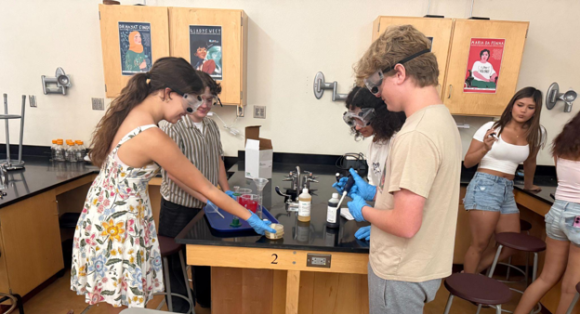
Although Spainhower has been teaching for 15 years and chairs the science department at Liberty High School, just outside San Francisco, this past school year was her first year teaching the ABE labs. She learned about the program through Sarah Yearby, a department chair (and ABE Master Teacher Fellow) at another school in the same district. “She has talked about her biotech program and the opportunities it gives her students and how great ABE San Francisco has been with supporting teachers,” she said. “I was really excited to go to the mini-training and see how I could make the concept of recombinant DNA and bacterial transformations more ‘real’ for my AP Bio students before the exam.”
Spainhower was especially impressed by how quickly the ABE San Francisco team got her a kit in advance of the AP exam and is excited to do a full week of ABE training this summer for a new biotech course she is starting. “My goal is to help students who would not traditionally see themselves as scientists realize that this is absolutely a dream they can have,” she said. “I am really excited and thankful that I get to bring this opportunity to my campus.”