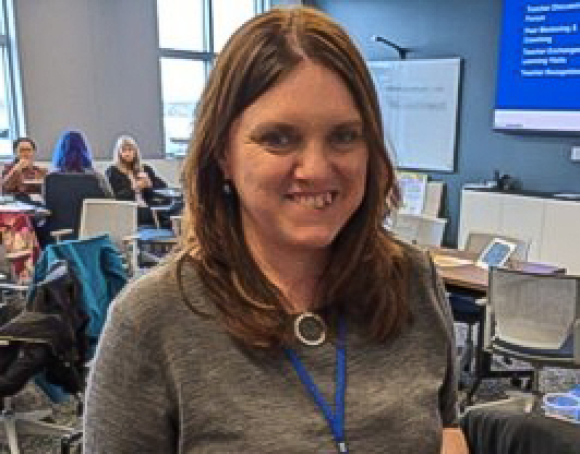
Susan Senior, an ABE Master Teacher Fellow in New South Wales, Australia, noticed her Year 12 students were struggling to grasp how plasmids work. “They just weren’t understanding how the plasmids would come apart and go back together,” she recalled. While the ABE laboratory kit includes a paper modeling activity, her students found the process hard to visualize.
Realizing her students needed a hands-on model to explore how plasmids can reconnect after they are cut, she set out to build one. Senior spent several months experimenting with different materials—including fabric, hook-and-loop fasteners (e.g., Velcro), and even heat-shrink plastic—but nothing worked. “You couldn’t find a way that they could go back properly—which is only in one direction with the right sticky ends—so it is quite a complicated concept for them to understand,” she said.
After several failed attempts, she was bouncing ideas off a colleague one day when the possibility of using magnetic jewelry beads came up. That weekend, she assembled plasmid fragments using jewelry wire, colored plastic beads, and magnetic fasteners.
When she shared the bead models with her students on Monday, she watched their faces light up. “The kids finally got the concept that they could put them back together . . . and that there were [many possible] combinations,” Senior said.
How the Magnetic Bead Model Works

Plasmids are small circular pieces of bacterial DNA. Scientists can insert genes from other organisms into bacterial plasmids to produce a desired protein—an important concept in biotechnology.
“As part of the ABE project, we take two plasmids. We cut them with restriction enzymes, and we put them back together. When you cut them, they have what is called a sticky end, and they only go back [together] with the same sticky end,” Senior explained. “But part of the program is getting them to understand all the possible ways that these plasmids can reconfigure.”
To make this process tangible, the bead model uses silver and gold magnetic fasteners to represent the different sticky ends. Because each magnet has a north and south pole and connects only in certain configurations, students can explore the different ways plasmids can recombine.
Making Complex Concepts Tangible
Beyond helping students explore possible plasmid recombinations, the bead model offers several other advantages, including helping them understand differences in plasmid size. “The students were not aware that one of the plasmids was a lot bigger than the other and some of the fragments are a lot smaller,” she explained. Senior used the number of base pairs for each ABE plasmid so she could build the model to scale, using more beads for larger fragments.
The model also helped students understand how plasmids can behave during gel electrophoresis. “They can have different configurations, which means they can twist, they can be whole circles, they can join with other circles, or they can be linear. This allowed them to see these configurations as well,” she said.
Senior believes models are becoming increasingly important instructional tools in science education because they help students visualize concepts that can otherwise be difficult to grasp. “Our students have changed—they are much more visual,” Senior observed. “We’re finding more and more that being able to model something is a way to get them to understand what we are doing, especially in biotechnology and biology.”
The Bead Model Gains Momentum
As a participant in the year-long ABE Master Teacher Fellowship, Senior was invited to share her bead model with other Master Teacher Fellows at a meeting in Boston in 2025, where it was met with great enthusiasm.
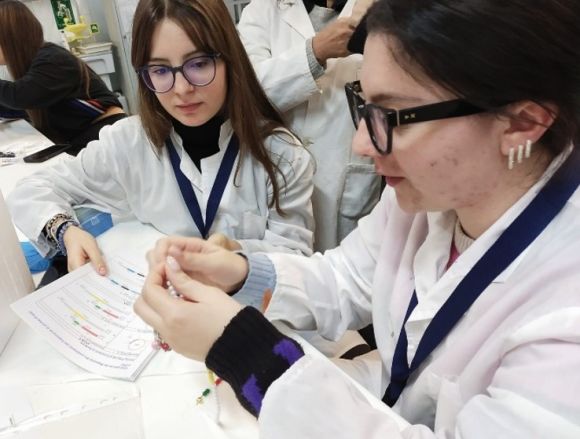
Since then, she has continued to hear positive feedback. “I’ve heard some feedback from other schools that they’ve thrown out the paper and are using this now. I know they are using it in Italy. One of my colleagues from Australia is using it. I’ve had a message from someone in California that they are using it as well,” said Senior.
While she is pleased to see teachers around the world using the model, Senior says her goal has always been the same. “In the long run, we are all just trying to do the same thing, which is trying to help our kids have a love for biology and understand what we are trying to teach them,” she said. “That’s where all this came from—is to get kids enthusiastic about science and to understand these kinds of complicated concepts.”
Despite her success in developing innovative teaching methods, what makes Senior most proud is inspiring her students to pursue careers in science. “Through the ABE program, at least three students have gone on to have a career in biotechnology,” she recalled. “I think that’s the best thing, when the kids take something they learned in high school, and they want to go on with it.”
To help other educators, Senior has generously shared her instructions for creating the magnetic bead model with the ABE community and beyond.
To use this model in your classroom, download the Biobeads Instructions and Biobeads Presentation.