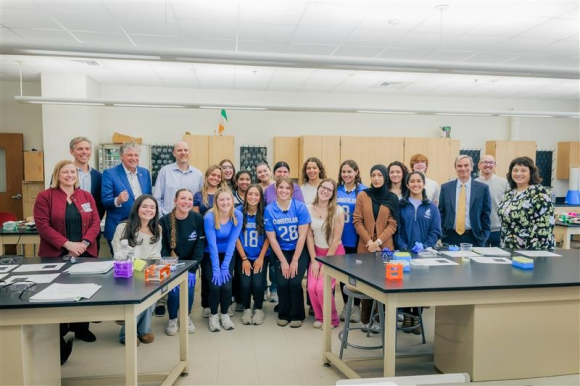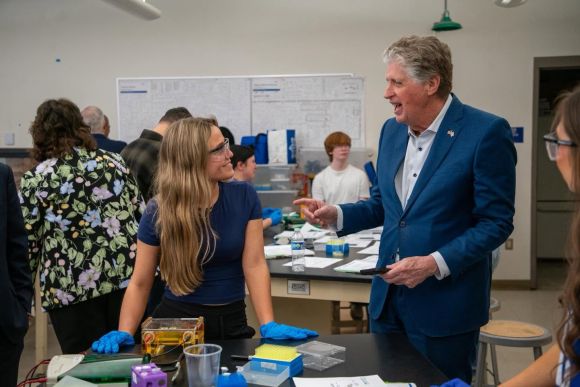
Students in Cumberland, Rhode Island, experienced a memorable day this past spring. Not only did they successfully complete a hands-on biotechnology lab, but the governor, Dan McKee, was there to witness their success.
Dr. Doreen Osgood, director of ABE Rhode Island and clinical associate professor in the University of Rhode Island (URI) biotechnology program, was eager to show the governor what was happening in classrooms throughout the state.
“This program provides all the reagents and the equipment to do the experiments,” said Osgood. “We are bringing real-life scenarios into the classroom.”
Planning the Visit
The visit was the result of months of coordination and more than 50 emails. Cumberland High School—where the governor once walked the halls as a student, and an early ABE adopter since 2007—was selected as the ideal location.
When Osgood reached out to Advanced Placement (AP) Biology and ABE teacher Michael Pariseau to arrange the visit, Pariseau asked if they could use the opportunity to redo ABE’s Foundations of Biotech restriction digest lab that had not gone as planned earlier in the year.
Since this particular lab requires significant planning and preparation, Arielle Chaves, ABE Rhode Island coordinator and lab technician, prepared the restriction digest and froze it the night before. Osgood and Chaves arranged to meet early. “We poured the gels in the morning, and we set the whole lab up,” said Osgood.
The Day of the Visit
By late morning on 27 March, a remarkable mix of people were gathering in Pariseau’s classroom. The governor, his staff, and local press arrived, followed by the superintendent and school principal. Two of Osgood’s URI colleagues came to assist: Brian Plouffe, a fellow faculty member, and Becky Sartini, the associate dean of academics. Brian Britson, Amgen Rhode Island’s site head and vice president of operations, also attended with three additional Amgen representatives.
Osgood set the stage for the lab activity: “Genetic engineering or gene cloning is made possible by using two key scientific discoveries: plasmids and restriction enzymes. Plasmids are small circular pieces of DNA that can replicate within bacterial cells; restriction enzymes cut DNA at specific locations and are used as molecular scissors.”
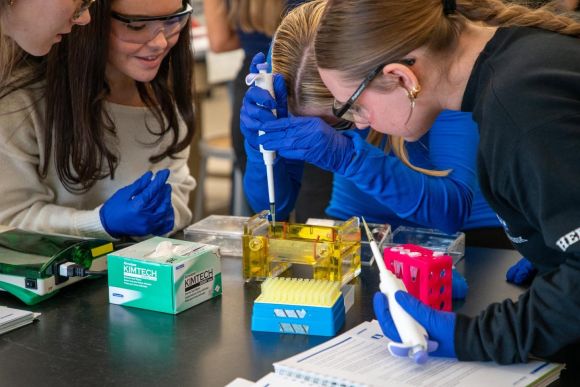
Pariseau’s AP students were given a genetically modified plasmid and were tasked with verifying that it contained the gene of interest—a gene that codes for a red fluorescent protein found in sea anemones. “It’s a quality check on the product that could be used to make a full-scale drug product,” Osgood explained. The process of harnessing genetically modified bacteria to create a useful product is similar to how human insulin is manufactured.
The governor circulated throughout the classroom, watching students work and talking to them about local sports and relatives of theirs he had grown up with. “He was very personable, talking to the students . . . It was a good sense of community,” said Osgood.
Summing up the day, Osgood said, “We were there for about an hour. We did the lab; we got great results. The governor went around. Students were excited; they were so happy that it worked.”
Growing Biotech in Rhode Island
The governor’s visit helped shine a spotlight on Rhode Island’s small but growing ABE program, which currently serves 35 teachers and 23 high schools. The program complements a larger effort to expand biotech opportunities in Rhode Island.
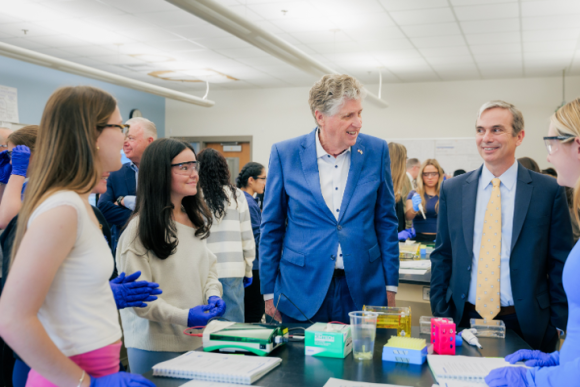
Osgood is enthusiastic about her dual roles as ABE director and faculty member for the biotechnology program at URI. Among her many hats, she coordinates the program’s laboratory activities, and in that role, she finds ABE instrumental for both recruitment and training.
“Financially, [some students feel they] cannot come to URI. But in Rhode Island, our community college is free for high school seniors,” said Osgood. “So, I tell them, ‘You can go to community college for two years, then you can transfer to a school like URI.’ I tell them, ‘You can do biotechnology.’”
Likewise, since Osgood’s URI undergraduates are required to do an internship program, ABE offers a perfect opportunity to grow her students’ skills and prepare them for future careers. “I have about two students all year round, different students that rotate in to help with the ABE program,” said Osgood.
“I’m trying to grow awareness of [the ABE program],” said Osgood. “Because even though we’re a small state, there are many people who do not know we exist.”
ABE’s Impact on STEM Education and Careers
One month after Governor McKee’s classroom visit, one of the AP students approached Osgood during URI’s Welcome Days. “She said, ‘Dr. Osgood, I don’t know if you remember me, but I was in the classroom with Mr. Pariseau when the governor came. You convinced me to come to the University of Rhode Island,’” recalled Osgood. “I was like, wow, you usually don’t see anything come of it, but . . . she remembered that.”
Osgood takes pride in where ABE students go next, including one who participated in ABE in high school and later became an intern while attending URI. “These students do very well,” she said. “In fact, a recent student just sent me a text that he got a job at Amgen. He graduated in December, and he said, ‘I want to thank you. They said that I went up on the list because of my experience with the ABE program.’”